The Community Kitchen at Fruit Valley serves Vancouver’s Fruit Valley neighborhood as a shared cooking space where residents gather to prepare meals together, learn culinary skills from diverse cultures, and access affordable kitchen facilities that many local apartments lack. Located in the heart of this vibrant community, the kitchen operates as both a practical resource and a cultural hub, bridging the gap between Vancouver’s newcomers and longtime residents through the universal language of food.
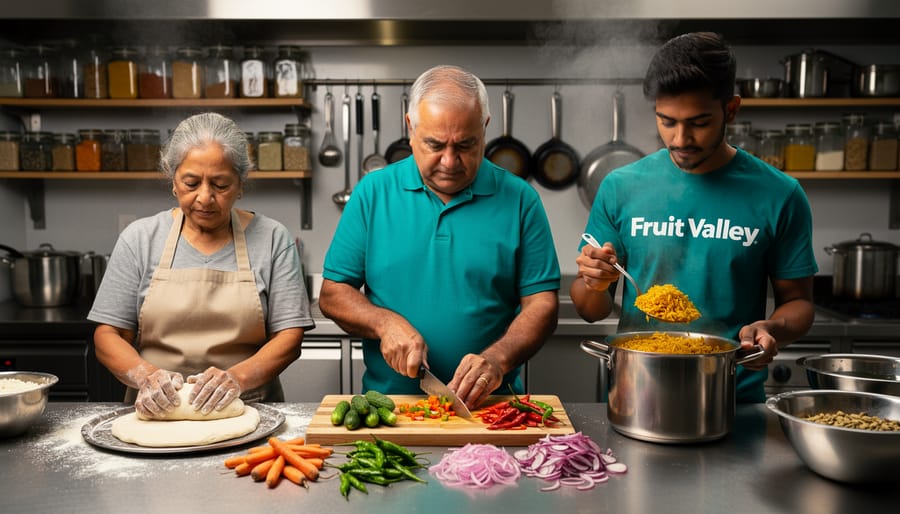
Walk into the space on any given evening and you’ll find the air thick with the aroma of cardamom-spiced rice mingling with the sharp tang of pickling vegetables, while someone at the next station kneads dough for fresh roti. This isn’t a cooking class in the traditional sense. Instead, it’s a living exchange where a grandmother from Punjab shares her generations-old samosa recipe alongside a student experimenting with West Coast fusion dishes, their conversations punctuated by the rhythmic chop of knives and bursts of laughter.
The kitchen welcomes anyone who needs a place to cook, whether you’re hosting a family gathering too large for your home kitchen, preserving seasonal fruit from local markets, or simply craving the companionship that comes from preparing food side by side with neighbors. Membership options range from drop-in sessions to regular timeslots, with sliding scale fees ensuring accessibility across income levels. Beyond the stainless steel counters and commercial-grade equipment lies something more valuable: a space where Vancouver’s rich cultural diversity transforms from abstract concept into shared meals, new friendships, and recipes passed hand to hand.
What Makes the Fruit Valley Community Kitchen Special
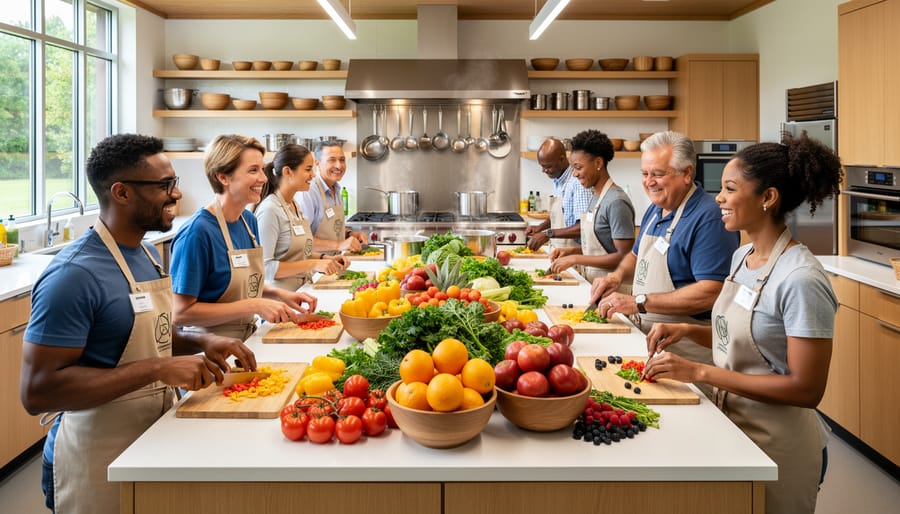
Step through the double doors on a Wednesday morning and your senses wake up immediately. Garlic sizzles in cast iron somewhere to your left. Fresh coriander releases its bright perfume as someone’s knife rhythmically works through a bundle. Laughter punctuates the steady percussion of chopping, and the air carries warmth that has nothing to do with the six-burner stoves lining the walls.
The Fruit Valley Community Kitchen occupies a renovated heritage building that once housed a small grocery. Its bones remember commerce, but its soul now feeds something deeper. Sunlight pours through tall windows onto four communal prep stations, each anchored by a massive butcher block table scarred with the stories of thousands of meals. Pots hang from ceiling racks like copper constellations. Open shelving displays donated cookware alongside handwritten recipe cards in half a dozen languages, their edges softened by flour-dusted fingers.
This kitchen doesn’t just teach people how to cook, it reminds them they belong to something bigger than themselves.
Run by a collective of neighborhood volunteers and supported by Vancouver’s community services network, the kitchen operates on a simple philosophy: food preparation is an act of care, and care builds community. The space welcomes everyone, from recent immigrants carrying generations of culinary wisdom to young professionals who never learned to dice an onion, from grandmothers teaching techniques their own grandmothers taught them to teenagers discovering that cooking can be creative expression.
What transforms this from facility to family is the intentional design of connection. Tables seat eight, forcing strangers into conversation. There’s no head chef barking orders, only gentle guidance and shared discovery. A Punjabi mother demonstrates the proper way to roll paratha while a retired fisherman from Nova Scotia shares his chowder secrets at the next station. Children underfoot learn by watching, stealing tastes, absorbing the unspoken lesson that feeding others is an act of love. The kitchen hums with purpose that transcends the practical need for nourishment.
The Heart of Community Cooking: Programs and Sessions
Cultural Cooking Circles
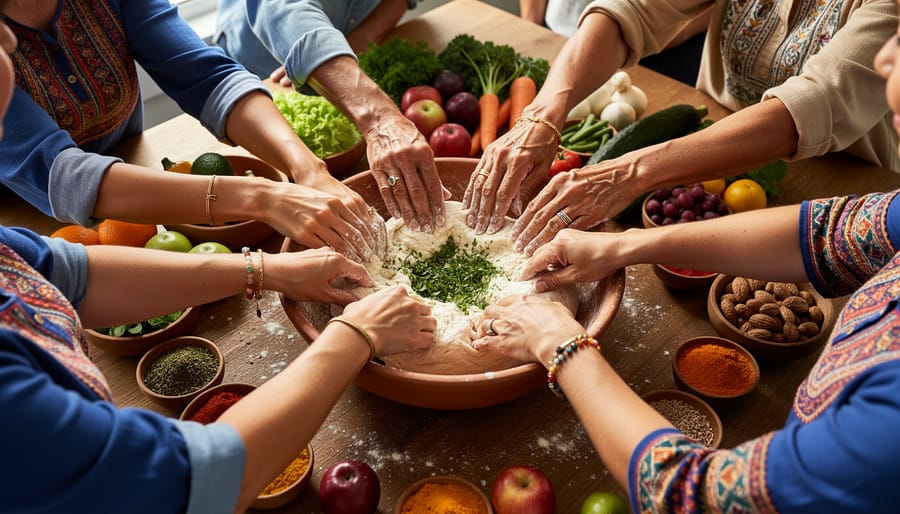
Step into a Tuesday evening circle and you might find Mrs. Chen guiding a group through the rhythmic precision of hand-pulling noodles, her fingers moving with the practiced grace of someone who learned the technique from her grandmother in Guangzhou. These hands-on sessions draw directly from Chinese food traditions while making space for Persian rice-cooking methods, Filipino lumpia-rolling techniques, and Indigenous salmon preparation.
The air fills with competing aromatics, toasted cumin from one station, fermenting cabbage at another, fresh cilantro being chopped nearby. Participants rotate through techniques, learning how to pleat a proper dumpling from someone whose family fled Vancouver-area Chinatown decades ago, then moving to master the flaky layers of homemade paratha with a recent arrival from Pakistan.
What makes these circles work isn’t just the recipes, it’s the stories traded over shared cutting boards. A Ukrainian grandmother explains why cold hands make better pastry while a young Indigenous participant demonstrates how to check wild salmon for doneness without a thermometer. Language barriers dissolve when everyone’s hands are covered in flour, and laughter sounds the same in every tongue when someone’s first attempt at spring rolls falls apart on the plate.
Skills Workshops and Food Literacy
The workshop calendar at Fruit Valley rotates through essential kitchen competencies that transform nervous beginners into confident home cooks. On a Thursday evening, you might find a dozen participants gathered around the central island learning proper knife grip, the instructor guiding hands to find that balance point where the blade becomes an extension of your arm, demonstrating the rock-chop motion that makes quick work of an onion without the tears.
Throughout the year, the kitchen offers practical sessions that address real cooking challenges:
- Knife skills and safe cutting techniques for efficiency and confidence
- Meal planning strategies that reduce waste and stretch grocery budgets
- Batch cooking methods for busy schedules and freezer-friendly meals
- Seasonal preserving, canning, pickling, and fermenting summer’s abundance
- Reading recipes and understanding cooking terminology
- Food safety fundamentals and proper storage techniques
The budget cooking sessions prove especially popular, where participants learn to coax maximum flavor from affordable ingredients. An instructor might show how a single whole chicken yields three meals, roasted breasts one night, thighs braised the next, bones simmered into golden stock. These aren’t abstract lessons but tangible skills participants use that same week, building food confidence alongside culinary knowledge.
Community Meal Programs
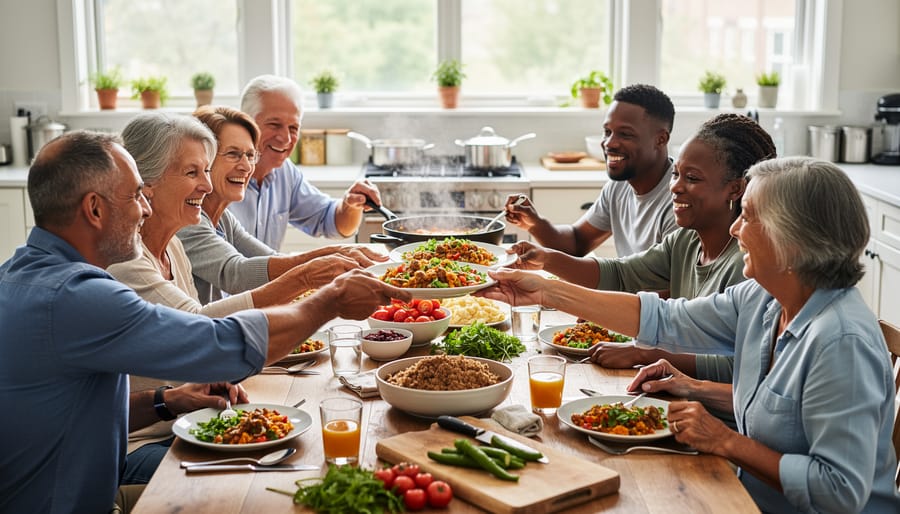
Every Thursday afternoon, a beautiful rhythm takes over the Fruit Valley kitchen. Strangers become teammates as they dice vegetables, stir simmering pots, and plate dozens of portions together. The communal meal program centers on a simple principle: cooking together nourishes more than just our bodies.
Participants contribute what they can, whether time, ingredients, or simply their presence, and everyone leaves with warm food. There’s no charity here, just neighbors sharing labor and the harvest of that work. Some nights, families gather around communal tables to eat what they’ve made, swapping stories between bites. Other evenings, people pack containers to bring home, extending the kitchen’s warmth to those who couldn’t attend.
The real magic isn’t in the recipes, though those change weekly. It’s watching someone who arrived alone leave laughing with new friends, having rediscovered the profound dignity of preparing food shoulder-to-shoulder with their community.
Meeting the Artisans and Home Cooks Behind the Magic
The kitchen truly comes alive through the people who gather here, the quiet masters of family recipes and enthusiastic volunteers who transform simple ingredients into edible stories.
On Tuesday afternoons, you’ll find Mrs. Chen rolling out dumpling wrappers with flour-dusted hands, her technique refined over six decades of making jiaozi for family gatherings in Guangzhou. She doesn’t measure anything, working entirely by feel as she pinches perfect pleats into each dumpling. Her sessions on local Chinese cuisine draw eager students who watch intently as she demonstrates the rhythm of folding, their own attempts endearingly lopsided beside her uniform crescent moons.
Across the kitchen, Marcus transforms humble root vegetables into Caribbean comfort food, his grandmother’s oxtail stew recipe simmering low and slow while he explains the importance of browning the meat properly. The aroma of thyme, allspice, and scotch bonnet peppers fills the space as he shares stories about Sunday dinners in Trinidad, where cooking was never rushed and family always gathered.
The volunteer coordinators are the kitchen’s connective tissue. Sarah, a retired teacher, arrives early every session to prep stations and welcome newcomers with genuine warmth. She remembers dietary restrictions, celebrates small victories when someone nails a technique they’ve been practicing, and somehow knows exactly when to offer encouragement or step back and let learning happen organically.
Then there’s young Amira, whose Afghan flatbreads emerge from the oven golden and blistered, each one brushed with garlic butter while still steaming. She teaches her mother’s naan recipe to anyone willing to learn, patiently explaining how the dough should feel stretchy but not sticky, alive under your hands.
These aren’t professional chefs putting on demonstrations. They’re neighbors sharing what they know best, creating magic through generosity and the simple act of cooking together.
How to Get Involved: Joining the Fruit Valley Kitchen Community
The welcoming doors of Fruit Valley’s community kitchen swing open every Tuesday and Thursday evening from 5:30 to 8:00 PM, with weekend sessions on the first and third Saturday of each month starting at 10:00 AM. No formal registration is required for drop-in sessions, just arrive with curiosity and a willingness to share in the collective experience of cooking together. First-timers often feel nervous about their skill level, but that anxiety melts away within minutes of stepping into the warm, aromatic space where volunteers greet newcomers with genuine smiles and perhaps a taste of whatever’s simmering on the stove.
For those wanting to volunteer regularly, the kitchen coordinator holds brief orientation sessions on the last Friday of each month at 6:00 PM. Volunteers can help with everything from prep work and dishwashing to leading cultural cooking sessions or managing the community pantry. The time commitment is flexible, some volunteers come weekly, others drop in when their schedules allow.
What should you bring? Just yourself and an apron if you have one, though the kitchen keeps extras on hand. Contributions of fresh herbs from your garden, family recipes you’d like to share, or specialty ingredients from your cultural background are always appreciated but never required. Most sessions operate on a small suggested donation of five to ten dollars to help cover ingredients and utilities, but no one is ever turned away for lack of funds. The kitchen also maintains a volunteer exchange program where participants can contribute their time in lieu of monetary donations, ensuring everyone can access this nourishing community space regardless of financial circumstances.
The Ripple Effect: Community Kitchens in Vancouver’s Food Ecosystem
When the Fruit Valley kitchen’s doors close each evening, the real work begins, not in the space itself, but rippling outward through every participant who carries home a container of stew, a new recipe scrawled on a napkin, or simply the memory of laughter shared over a cutting board. This isn’t just feel-good storytelling. Community kitchens like Fruit Valley are quietly reshaping Vancouver’s relationship with food at the most fundamental level.
The impact starts with the immediate: food security. By teaching residents to stretch a dollar through batch cooking, preserving seasonal produce, and minimizing waste, these kitchens put nutrition within reach for families navigating Vancouver’s soaring cost of living. But the transformation runs deeper. Each cooking circle preserves culinary techniques that might otherwise vanish within a single generation, the precise hand-rolling of Persian dolmeh, the timing required for perfect Filipino lumpia, the grandmother’s touch in Punjabi dal that no cookbook captures.
These sessions become archives of community food culture living and breathing. The Vancouver Food Community Connection network links spaces like Fruit Valley across neighborhoods, creating pathways for knowledge exchange and resource sharing. A preserving workshop developed in East Van travels to Fruit Valley; a budget-cooking technique refined here spreads citywide.
Perhaps most critically, community kitchens build social infrastructure. In a city where isolation often hides behind politeness, standing elbow-to-elbow while chopping vegetables creates bonds that extend beyond the kitchen, neighbors who check on each other, informal support networks, genuine neighborhood resilience that no policy can manufacture.
The steam rising from a shared pot. The rhythm of knives on cutting boards keeping time with laughter. The moment a stranger becomes a neighbor over a plate of food made together. This is what happens at Fruit Valley’s community kitchen, not occasionally, but every single day.
Beyond the recipes learned and meals shared, something profound unfolds here. Loneliness dissolves into belonging. Cultural barriers transform into bridges built with cardamom and conversation. Skills pass from weathered hands to eager ones, carrying forward traditions that might otherwise fade.
You don’t need to be a skilled cook to belong here. You just need to show up hungry, for connection as much as sustenance. Come for the food, stay for the community. In a city where isolation can feel as heavy as the rain, Fruit Valley’s kitchen proves that the simple act of cooking together still holds the power to nourish us in ways we desperately need.
Leave a Reply